
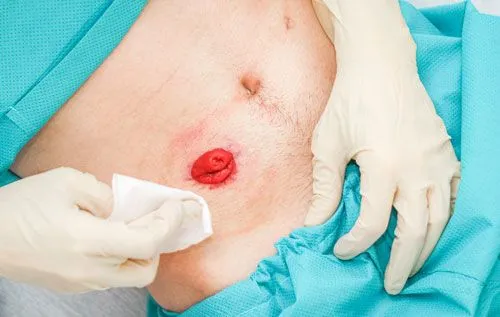
WHAT IS AN OSTOMY?
An ostomy is a surgically created opening in the abdominal wall that connects the intestines to the body surface. The part of the intestine brought through the abdomen surface is called a “stoma” or “ostomy”. Ostomies are frequently created as a part of intestinal surgery to provide an alternative route for intestinal waste to exit the body. The most common types of ostomies involve either connecting the small intestine (ileostomy) or the large intestine (colostomy) to the abdominal wall. Ostomies can be either temporary or permanent.
WHY IS AN OSTOMY NECESSARY?
Surgeons may use ostomies to manage complicated abdominal problems or to facilitate healing at the surgical site.
Reasons where surgery may involve an ostomy:
- Cancer
- Trauma
- Inflammatory bowel disease (IBD) such as Crohn’s disease or Ulcerative Colitis
- Bowel obstruction (intestinal blockage)
- Infection or perforation of the intestine
- Severe diverticulitis (inflammation of tiny pockets that commonly form in the colon wall)
- Fecal incontinence (inability to control bowel movements)
- Severe constipation
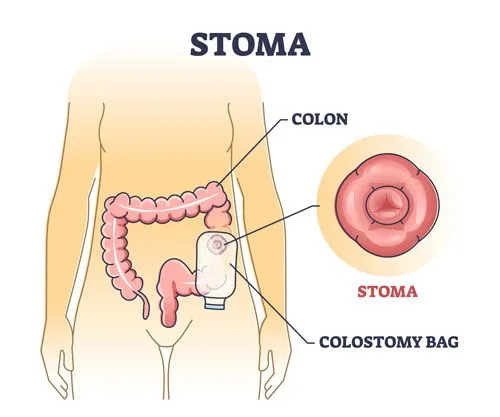
WHAT ARE THE TYPES OF OSTOMIES?
Your colorectal surgeon can provide answers regarding which part of the bowel the ostomy is made of (colon or small intestine), whether it’s intended to be temporary or permanent, and whether it is an “end” or a “loop” ostomy.
- Ileostomy: Connects the last part of the small intestine to the abdominal wall.
- Colostomy: Connects a part of the colon (large intestine) to the abdominal wall.
- Temporary Ostomy: This type of ostomy diverts the passage of stool away from the intestines below the stoma. Temporary ostomies are typically created in the process of treating complicated abdominal problems, or to divert the stool to facilitate time for healing. These ostomies may be reversed when deemed suitable by your colorectal surgeon.
- Permanent Ostomy: A permanent ostomy provides a long-term solution for evacuating waste. This may become necessary when a disease, or its treatment, impairs normal intestinal function. It also is necessary when the anus or the muscles that control elimination must be removed or if they no longer function correctly.
- “End” Ostomy: This type of ostomy is created by bringing the end of a bowel segment to the abdominal wall. The stoma is opened and secured to the skin with dissolvable stitches.
- “Loop” Ostomy: This type of ostomy is created by bringing the entire loop of bowel to the abdominal wall. A cut is made only halfway around the intestine such that there are two ends (upstream and downstream) which are both secured to the skin with dissolvable stitches.
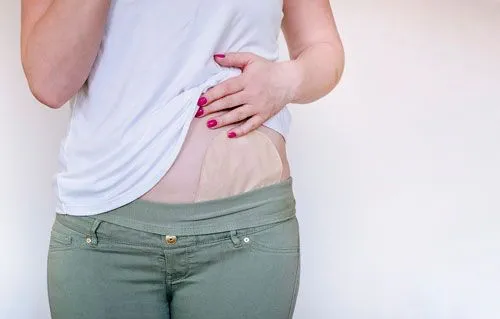
WHAT IS AN OSTOMY BAG?
Once your ostomy is created, your stool will naturally pass through the stoma. An ostomy appliance (or ostomy bag) consists of a plastic pouch that sticks to the skin around your ostomy using an adhesive skin barrier. The purpose of the appliance is to collect the stool and gas in a secure, odor-free fashion. The pouch is disposable and is emptied or changed as required.
WHERE WILL THE OSTOMY BE PLACED?
Prior to surgery, your surgeon or a Wound Ostomy and Continence Nurse (WOCN) will assess your abdomen to locate a suitable place on your abdominal wall for the opening or stoma. Ideally, the ostomy is placed on a flat portion of the front of your abdomen that is easily visible to you. A colostomy is typically placed to the left of the navel, while an ileostomy is usually placed to the right.
HOW DO I CARE FOR MY OSTOMY POST-SURGERY?
Your ostomy nurse (WOCN) will provide instructions on how to attach and care for an ostomy appliance. The physicians and nurses will cooperate with you on any necessary changes to your diet.
It is crucial to keep the skin around the ostomy healthy by using a well-fitting ostomy appliance that remains securely in place. Each time you change your skin barrier and pouch, examine the skin closely for any swelling, redness, rash, or other signs of irritation.
HOW DOES AN OSTOMY IMPACT MY BOWEL MOVEMENTS?
The frequency and quantity of your bowel movements that empty through the ostomy will vary based on the type of ostomy, your diet, and your pre-surgery bowel habits. It’s important to establish a routine for changing your pouch. You may need to empty your ostomy bag several times per day, but typically, you will only need to completely replace the ostomy appliance on your skin two to three times per week.
WILL MY DIET BE LIMITED?
Many patients can resume a regular diet with minimal restrictions after ostomy surgery. Depending on the type of ostomy, you may need to adjust your eating habits to manage the frequency and consistency of bowel movements. You will learn to monitor how different foods affect your ostomy function. Over time, many patients can gradually reintroduce foods into their diet. It’s beneficial to chew food thoroughly, stay well-hydrated, and avoid certain high roughage foods, such as green leafy vegetables. After recovering from surgery, most patients do not have significant dietary restrictions.
WILL MY PHYSICAL ACTIVITIES BE LIMITED?
All activities including recreational sports and activities may be eventually resumed. Once healing from surgery is complete, all activities, including bathing, showering, recreational sports, and vigorous activities like running and swimming, can typically be resumed. If there is concern that the ostomy bag may become loose during such activities, a special belt or binder can be used to secure it in place. It’s important to note that many public figures, famous entertainers, and even professional athletes with ostomies continue to lead active lives without limitations.
Most patients with an ostomy can continue their usual sexual activity. Some patients may initially worry about their partner finding them unattractive due to the ostomy bag. Building a strong relationship, allowing time for adjustment, seeking support from groups, and maintaining patience are helpful in addressing these concerns. Any type of surgery can impact how you perceive your body, including having an ostomy. Adjusting to these changes may take time, but maintaining a positive outlook, adapting to new routines, and returning to normal activities are achievable goals.
WILL OTHER PEOPLE KNOW THAT I HAVE AN OSTOMY?
Unless you disclose it, most people won’t know you have an ostomy. An ostomy can typically be easily concealed by clothing. You have probably been among people with ostomies and did not even realize it!
WHAT ARE THE COMPLICATIONS OF AN OSTOMY?
Complications can arise with an ostomy. Initially, adjusting to the fit and function of the appliance may take time, and accidents or leakage from the bag can occur. However, once you become accustomed to using the stoma appliance, most common issues such as local skin irritation are easily manageable.
Dehydration can commonly occur especially with ileostomies (an ostomy using the small intestine). If you notice high output from the stoma over 1 liter per day, you may need to start fiber supplements or anti-diarrhea medications. Fiber supplements include psyllium husk (Metamucil) and anti-diarrhea medications include loperamide (Imodium).
Significant changes in weight, whether loss or gain, can affect how the ostomy sits on your abdomen. Some individuals may experience complications such as a hernia (weakening on the abdominal wall around the ostomy) or prolapse (a protrusion of the bowel). Surgery is only necessary for these issues if they cause significant symptoms.
ABOUT COLON AND RECTAL SPECIALISTS
Colon and Rectal Specialists was founded in 1913. We are a group of dedicated fellowship-trained colorectal surgeons. We are experts in the surgical and non-surgical treatment of diseases of the colon, rectum, and anus. Our surgeons have all completed advanced surgical training in the treatment of these diseases in addition to full general surgical training. We are well-versed in the treatment of both benign and malignant diseases of the colon, rectum, and anus and are able to perform routine screening examinations and surgically treat conditions when indicated.
ABOUT C.A.R.E.S. CENTER
Colon and Rectal Endoscopy and Surgery (CARES) Center is our state-of-the-art Ambulatory Surgery Center. Our center has been accredited by the Accreditation Association for Ambulatory Health Care (AAAHC) and has been given Medicare Deemed Status by CMS. We perform a variety of services including: screening colonoscopies, hemorrhoidectomy, abscess and fistula surgery, fissure surgery, pilonidal surgery, and surgery to treat fecal incontinence. Learn more about us at www.crspecialists.com.
