
WHAT IS CROHN’S DISEASE?
Crohn's disease is a chronic inflammatory disease potentially affecting all parts of the gastrointestinal tract, from the mouth to the anus. It typically affects the last part of the small intestine (ileum) and/or the large intestine (colon and rectum). Crohn’s disease involves the body’s immune system attacking the intestinal tract, leading to inflammation.
Patients with Crohn’s disease experience inflammation that can occur at any point and can affect one or more areas of the GI tract. There is no way to predict who will develop this illness or when a flare-up might appear. It is a chronic condition that can show up unexpectedly, can go away without explanation, and can recur without any clear reason. Unlike ulcerative colitis, Crohn's disease cannot be cured. However, medical and surgical treatments of Crohn’s disease often provide patients with long periods of symptom relief.
WHO IS AT RISK FOR CROHN’S DISEASE?
Crohn’s disease can impact individuals of any age, but most often is initially diagnosed between the ages of 20 to 30 or later in life between ages 60 to 70. This disease affects both men and women equally. If there is a family history of Crohn's disease or inflammatory bowel disease, there is a slightly higher chance of developing it. Smoking also increases the risk of developing the disease.
Crohn’s disease is most prevalent among individuals living in northern climates. Approximately 20 percent of individuals with Crohn’s disease have a family member, usually a sibling, and sometimes a parent or child, with some form of inflammatory bowel disease.
Crohn’s disease and a related condition called ulcerative colitis are commonly classified as inflammatory bowel disease. These two diseases affect approximately two million individuals in the U.S.
WHAT CAUSES CROHN’S DISEASE?
The exact cause of this disease is unknown. Current research is centered on abnormalities in the immune system and bacterial infection. This focus is supported by evidence showing symptom relief with immune-suppressing medications. Crohn’s disease is not contagious.
WHAT ARE THE SYMPTOMS OF CROHN’S DISEASE?
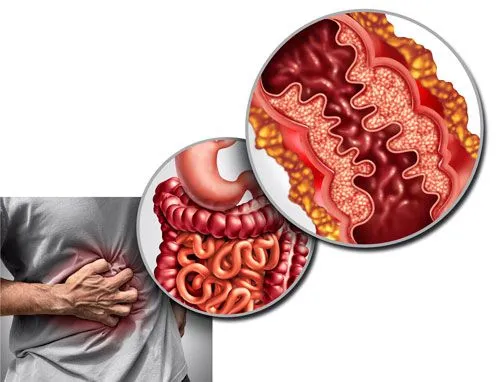
Because Crohn’s disease can affect any section of the intestine, symptoms may vary greatly among patients. Crohn’s disease typically appears as abdominal disease (affecting the small or large intestine), as anorectal disease (affecting the anus and/or rectum), or both. Symptoms vary widely and may include intestinal cramping, pain, persistent diarrhea or constipation, bleeding with bowel movements, fever, fatigue, weight loss, and recurrent rectal abscesses. Not all patients will have all of these symptoms, and some may not experience any of them at all. In some cases, Crohn's disease can suddenly and severely present itself, leading to urgent surgery due to the patient’s rapid decline in health. Patients with Crohn’s disease can have the same symptoms as those with other types of inflammatory bowel diseases such as ulcerative colitis.
In Crohn’s disease, some patients may develop fistulas, which are abnormal connections between the bowel and other body parts including other bowel loops, bladder, vagina, or skin. Anorectal symptoms include anal pain and/or drainage from the perianal area.
WHAT IS THE EVALUATION OF CROHN’S DISEASE?
The initial assessment of the patient involves taking a detailed medical history and performing a physical examination. This is followed by laboratory tests, examination of the bowel with colonoscopy and sometimes upper endoscopy, and radiological imaging studies.
The laboratory tests typically include basic blood work to assess inflammation or infection. General laboratory tests are not usually definitive in diagnosing Crohn’s disease.
The most common method to definitively diagnose Crohn’s disease is with a colonoscopy, which allows for a detailed evaluation of the colon, rectum, and the last portion of the small intestine. Biopsies can be taken to be evaluated by a pathologist to determine if there is evidence of active inflammation and features suggestive of Crohn’s Disease.
Radiographic (imaging) studies such as CT or MRI scans of the abdomen and pelvis are conducted to evaluate for inflammation or narrowing of the bowel, abscesses (pockets of infection), or fistulas (connections between the bowel to other organs). These scans typically involve the patient drinking a contrast solution to enhance visibility of these abnormalities. Additional tests, such as enterography, may be ordered by the physician to provide more detailed visualization of the inflammation and affected areas.
WHAT ARE THE TREATMENT OPTIONS FOR CROHN’S DISEASE?
Initial treatment typically involves medication. While there is no definite cure for Crohn’s disease, the goal of medical management is to achieve and maintain a non-inflamed state and prevent recurrence of flare-ups. Along with smoking cessation, dietary modifications may also be suggested. Corticosteroids, such as prednisone and methylprednisolone, are frequently to induce remission of an acute flare-up. In addition, various other anti-inflammatory medications are commonly prescribed to maintain remission.
Emergency surgery may become necessary if complications occur such as intestinal perforation, bowel obstruction unrelieved with anti-inflammatory medications, or uncontrolled bleeding. Less urgent indications for surgery may include abscess formation, fistulas (abnormal communications from the intestine), severe anal disease, or when the disease persists despite appropriate medical therapy. It is important to keep in mind that surgical removal of the affected segment(s) of intestine does not cure the disease. While it addresses the immediate issue, Crohn’s disease frequently recurs in areas previously not involved. Recurrent flare-ups often occur adjacent to the prior surgical site along the intestines.
Not all patients experiencing complications of Crohn’s disease require surgery. This decision is best made after consultation with both your gastroenterologist and colorectal surgeon.
SURGICAL TREATMENT
Surgery for Crohn's disease can be either scheduled (elective surgery) or performed as an emergency procedure.
- Emergency surgery is necessary for the following conditions:
- Bowel perforation. This is where a hole in the bowel causes fecal matter to leak into the abdomen. This can lead to sepsis if emergent surgery is not performed to contain the spillage.
- Complete bowel blockage. Most of these patients will improve with anti-inflammatory medications. Sometimes, the blockage is so severe that it requires emergency surgery.
- Severe bleeding. Most bleeding related to Crohn’s disease will stop with minimally invasive techniques (such as colonoscopy or interventional radiology) and allowing time for the body to create clots. In rare instances, patients require emergency surgery to stop bleeding.
- Anorectal abscess. These usually will not go away with antibiotics alone and require surgery in the semi-urgent setting. This is usually not an emergency.
Elective surgery for Crohn’s disease is considered for patients experiencing a poor quality of life despite medical treatment. This option also applies to patients who no longer respond to medical therapy, or cannot tolerate long-term medication due to significant side-effects.
Surgery aims to effectively treat the section of diseased bowel. The most common types of surgery for Crohn’s disease are:
- Ileocolic resection: This involves the removal of the end of the small intestine and the beginning of the large intestine.
Stricturoplasty: This procedure is performed to relieve bowel strictures (narrowing of the intestine).
Small bowel resection (enterectomy) and/or large bowel resection (colectomy or proctocolectomy): This involves removing the diseased section of the large or small intestine. After resection, a colostomy or ileostomy may be necessary for elimination of waste. A colostomy or ileostomy may be temporary or permanent depending on the extent of disease. It is important to have these discussions with your surgeon to determine which type of surgery is best for you.
Fistula resection: This involves removing abnormal passageways that have formed between the bowel and other structures, such as other parts of the bowel, bladder, or skin.
All surgical procedures are performed with the goal of preserving as much bowel length as possible to improve the patient's potential for more normal digestive function. Since Crohn’s disease has no cure and recurrence is common, surgeons aim to minimize the removal of healthy intestine during each operation. The likelihood of recurrence depends on the severity and extent of the disease.
After the removal of a portion of the bowel, it is not always possible or advised to reconnect the remaining parts into a continuous length. In such cases, a patient may require an ostomy to manage stool passage. An ostomy involves surgically creating an opening between the small or large intestine and the surface of the abdominal wall and skin. The visible part of the bowel on the abdominal surface is called a stoma. Ostomies may be either permanent or temporary, depending on the specific medical circumstances.
Anorectal surgery for Crohn’s disease often involves addressing an anal abscess by draining the infected cavity. During this procedure, the abscess is opened to release the fluid. In cases where the infection continues and there is ongoing fluid production, a fistula (connection to the diseased anus or rectum draining outside next to the anus) may form. To manage a fistula and promote controlled drainage, the surgeon may place a seton. This is a piece of suture or thin rubber band-like material that is threaded through the fistula tract. This prevents the formation of undrained abscess pockets and allows for ongoing drainage. The seton is typically left in place for several weeks or until medical management can effectively control drainage. Once the drainage is managed, the surgeon can consider removing it, but sometimes a seton may remain indefinitely.
Anorectal surgery is also performed to correct an anal fistula (an abnormal passageway between the rectum and skin). In cases where there are complex or multiple significant anal fistulas, patients may be advised to undergo ostomy creation. This surgical procedure diverts stool away from the affected anal area, allowing the fistulas to heal effectively with medical management. Once the wounds have completely healed, the ostomy can sometimes be reversed. Colostomy reversal depends upon the individual's overall health status and the progress of their Crohn's disease.
WHAT DO I NEED TO DO AFTER SURGERY?
After undergoing surgery, it is crucial to promptly resume care with your gastroenterologist. During your follow-up appointment, your gastroenterologist will likely introduce a medication regimen to manage the disease and reduce the chances of recurrence.
Patients with inflammatory bowel disease (Crohn’s disease or ulcerative colitis) also have an increased risk of developing colon and rectal cancers. In individuals with longstanding colonic Crohn’s disease, the risk can be increased by 2-3 times compared to patients without Crohn’s disease. Current guidelines advise these patients to undergo an initial screening colonoscopy within eight years after the onset of symptoms. Subsequent surveillance colonoscopies are recommended depending on the findings of the initial screening colonoscopy.
HOW CAN I REDUCE RECURRENCE?
Recurrence frequently occurs in patients who smoke or stop their medications for Crohn’s disease. Crohn's disease is a chronic, lifelong condition that demands continuous attention to manage effectively.
ABOUT COLON AND RECTAL SPECIALISTS
Colon and Rectal Specialists was founded in 1913. We are a group of dedicated fellowship-trained colorectal surgeons. We are experts in the surgical and non-surgical treatment of diseases of the colon, rectum, and anus. Our surgeons have all completed advanced surgical training in the treatment of these diseases in addition to full general surgical training. We are well-versed in the treatment of both benign and malignant diseases of the colon, rectum, and anus and are able to perform routine screening examinations and surgically treat conditions when indicated.
ABOUT C.A.R.E.S. CENTER
Colon and Rectal Endoscopy and Surgery (CARES) Center is our state-of-the-art Ambulatory Surgery Center. Our center has been accredited by the Accreditation Association for Ambulatory Health Care (AAAHC) and has been given Medicare Deemed Status by CMS. We perform a variety of services including: screening colonoscopies, hemorrhoidectomy, abscess and fistula surgery, fissure surgery, pilonidal surgery, and surgery to treat fecal incontinence. Learn more about us at www.crspecialists.com.
